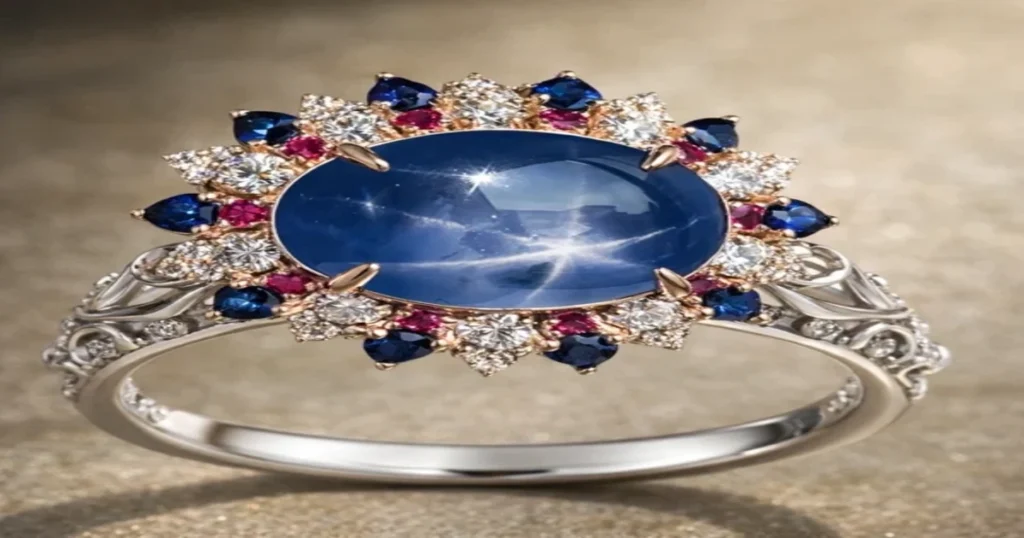
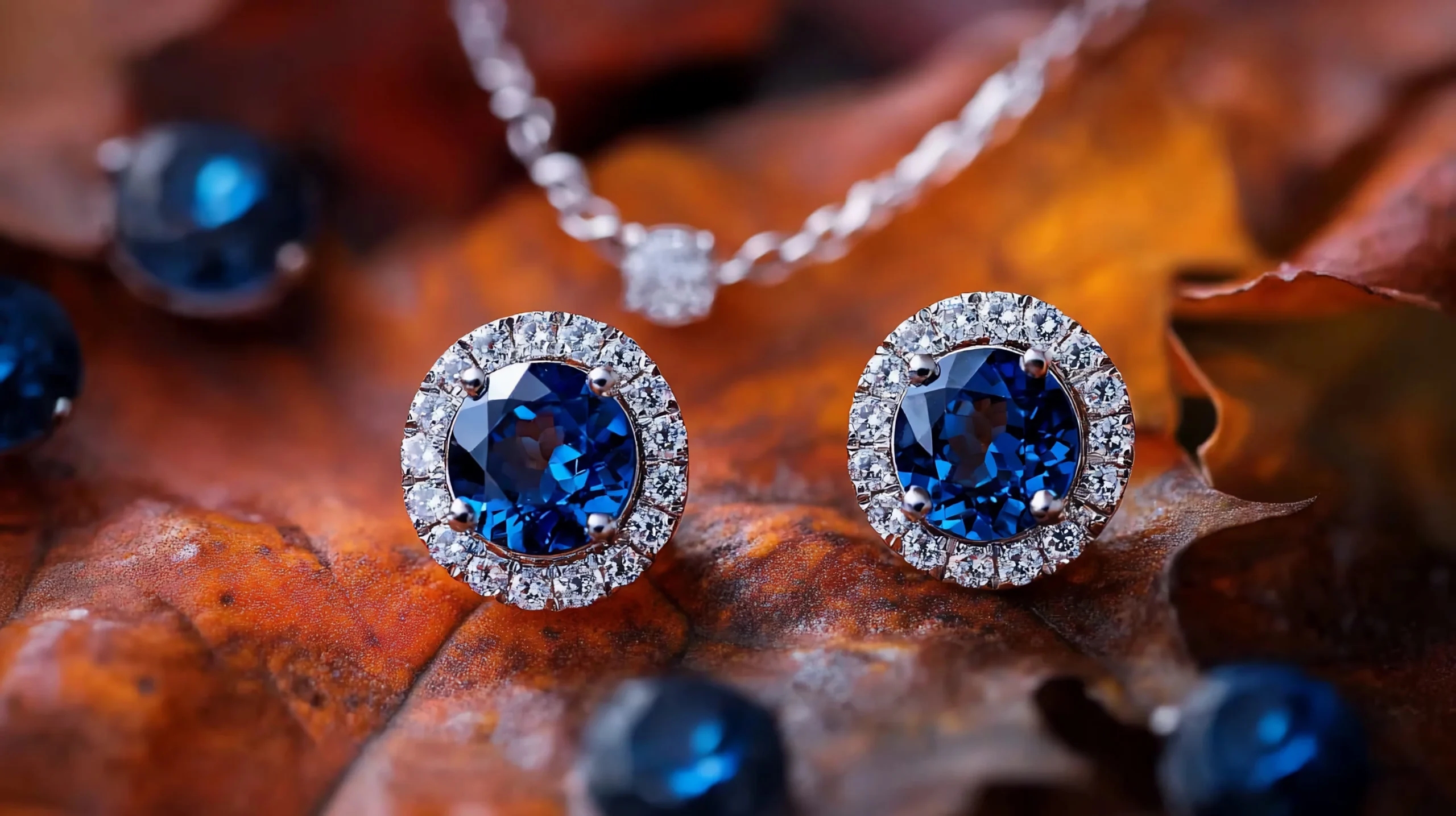
Every year, roughly 5% of engaged couples in the United States now choose a colored gemstone center stone over a traditional diamond — a number that has nearly doubled since 2018, according to The Knot’s Annual Jewelry & Engagement Study. Among those colored stone choices, two blues dominate wishlist searches and showroom conversations alike: tanzanite and blue sapphire. They’re both breathtaking. They’re both rare. But they are not the same stone, and the differences matter — especially when the ring is meant to last a lifetime.
If you’re weighing a tanzanite vs blue sapphire engagement ring, you’re already thinking beyond the conventional. You want something that feels like *you* — vivid, considered, and unlike anything mass-produced. This guide will walk you through every attribute that matters: hardness, rarity, price per carat, treatment standards, long-term wearability, and how each stone performs in a custom setting. By the time you finish reading, you’ll know exactly which gemstone belongs on your finger — and why.
What Makes Tanzanite One of the Rarest Gemstones on Earth?
Tanzanite is found in a single location on Earth — a narrow strip of land near Mount Kilimanjaro in Tanzania. With no secondary deposits discovered anywhere globally, the Gemological Institute of America (GIA) considers it geologically irreplaceable. Current mining estimates suggest the supply could be fully exhausted within 20 to 30 years, making tanzanite one of the rarest gemstones available today.
Tanzanite’s scarcity isn’t just geological poetry — it has real implications for value. Unlike sapphire, which is mined across Sri Lanka, Madagascar, Kashmir, Myanmar, and Australia, tanzanite has no backup source. The Merelani Hills of northern Tanzania are it. Full stop.
What makes tanzanite visually extraordinary is its trichroism — the ability to display three different colors (blue, violet, and burgundy) depending on the viewing angle and lighting conditions. Fine tanzanite in natural daylight appears a rich velvety blue-violet; under incandescent light, it deepens to an almost indigo-plum. This optical phenomenon is unique to the species and contributes significantly to its allure for collectors and designers.
The American Gem Trade Association (AGTA) designated tanzanite as a December birthstone in 2002 — only the third addition to the traditional birthstone list in over a century. That recognition reflected the stone’s growing prominence in the fine jewelry market, not just its novelty.
At DiamondsNColors, we source our tanzanite directly through verified channels with full origin traceability.
Blue Sapphire: The Engagement Stone with 2,000 Years of History
Blue sapphire has been worn by royalty, clergy, and collectors for over two millennia. It scores a 9 on the Mohs hardness scale — second only to diamond — making it the most durable colored gemstone commonly used in engagement rings. Its color range spans pale cornflower to rich royal blue to deep navy, with Kashmir origin stones widely considered the most prized by collectors and auction houses worldwide.
Blue sapphire’s dominance in bridal jewelry received a modern cultural reset in 1981 when Prince Charles presented Princess Diana with a 12-carat Ceylon sapphire ring — a piece now worn by Catherine, Princess of Wales. According to Sotheby’s auction records, Kashmir blue sapphires have fetched upward of $200,000 per carat at major auctions, establishing sapphire as a legitimate store of value alongside colored diamonds.
For everyday wearers, sapphire’s Mohs 9 hardness is a meaningful practical advantage. It resists surface scratching from routine contact with metals, granite countertops, and daily handling in a way that softer stones simply cannot match. The GIA grades blue sapphire on the same colored stone criteria used for all corundum: hue, tone, saturation, clarity, and cut — with “strongly saturated violetish-blue to blue” representing the highest commercial color grade.
Treatment is a critical factor in sapphire pricing. The majority of commercially available blue sapphires undergo **heat treatment** — a process that improves color and clarity and is considered standard and accepted by the trade. However, GIA-certified *unheated* blue sapphires command a significant premium: typically 30–50% above treated equivalents of the same quality, according to the Rapaport Diamond Report’s colored stone supplement.
Mohs Hardness and Daily Wearability: What No One Tells You Before You Buy
The Mohs hardness scale measures a gemstone’s resistance to surface scratching — not its toughness or overall durability. Tanzanite, at 6.5–7, is significantly softer than blue sapphire at 9. For a ring worn daily on your dominant hand, this difference is meaningful: tanzanite requires a protective setting and more frequent professional cleaning, while blue sapphire tolerates the rigors of everyday wear with far less intervention.
This is the practical conversation most jewelry buyers don’t have until after they’ve made their choice — and it’s one our team at DiamondsNColors has every week.
Mohs hardness is specifically about *scratch resistance*. A tanzanite stone won’t crack from a bump the way an emerald might (emerald has significant cleavage issues), but it will show surface abrasions over time if worn in a simple four-prong solitaire without protective design elements. Household dust contains quartz particles rated at Mohs 7 — which means your tanzanite can technically be scratched by something as mundane as the dust on your bedside table.
The solution isn’t to avoid tanzanite. It’s to *design for tanzanite*. A well-executed bezel setting fully encases the girdle of the stone, protecting the most vulnerable edge. A halo of smaller diamonds or sapphires adds both sparkle and structural protection. An east-west or low-profile setting reduces the stone’s exposure to impacts.
Blue sapphire, by contrast, can comfortably wear in virtually any setting configuration — from the most delicate four-prong cathedral to a tension-set contemporary design — without special accommodation.
DiamondsNColors’ [custom design studio](link: /custom-order/) specializes in pairing your chosen stone with a setting architecture that’s built for its specific properties. If you fall in love with tanzanite, we’ll design a ring that protects it beautifully — and you’ll never feel like you compromised on style to get there.
Price Per Carat in 2026: What You Can Expect to Pay in the USA
In 2026, fine-quality tanzanite in the 2–5 carat range is priced between $300 and $1,200 per carat in the US market, with exceptional AAA-grade stones reaching $1,500 per carat and above. Blue sapphire pricing is wider: standard commercial quality runs $500–$2,000 per carat, while top Ceylon or unheated stones reach $5,000–$50,000+ per carat depending on origin and certification. Both gems offer meaningful value in the $3,000–$15,000 engagement ring budget range.
For most couples shopping in the $5,000–$15,000 range — which represents the sweet spot of the Las Vegas fine jewelry market — both stones offer compelling value, but in different ways.
Tanzanite value proposition: A 3-carat, AAA-grade oval tanzanite with strong violet-blue saturation and excellent cut might retail for $2,500–$4,000 for the stone alone. Set in a custom 14k white gold halo with pavé diamonds, your total ring investment could be $5,000–$8,000 — delivering a visually dramatic, genuinely rare piece at a price point that would buy only a modest diamond solitaire.
Blue sapphire value proposition: A 2-carat, heat-treated royal blue sapphire from Sri Lanka with GIA certification might retail for $3,000–$6,000 for the stone. Unheated stones at this weight and color quality can easily double or triple that figure. Sapphire’s established resale market and collector demand make it a stronger investment vehicle, especially at the top of the quality spectrum.
According to GemVal’s 2025 colored gemstone market index, both tanzanite and fine blue sapphire appreciated in dollar-denominated value over the past three years, with tanzanite showing particular momentum in the American millennial buyer segment.
Ethical Sourcing and GIA Certification: What Matters for Your Purchase
For both tanzanite and blue sapphire, ethical sourcing and independent laboratory certification are non-negotiable quality benchmarks. GIA (Gemological Institute of America) colored stone reports document origin, treatment status, and quality grades — protecting your investment and confirming the stone’s identity. When buying a tanzanite or sapphire engagement ring in the USA, always request a GIA report or equivalent from a respected lab such as AGL or Gübelin.
Tanzanite’s single-source origin from Tanzania actually simplifies parts of the supply chain traceability equation — you always know where it came from geographically. The Tanzanite Foundation established the Tanzanite One Mining Limited ethical framework, which governs responsible mining practices and community benefit programs in the Merelani region.
Sapphire sourcing is more complex due to its multi-country origin profile. Kashmir sapphires — widely considered the finest in the world for their distinctive “velvety” saturation and limited supply from mines largely closed since the 1880s — are extraordinarily rare and command astronomical premiums. Ceylon (Sri Lankan) sapphires represent the most commercially available premium tier, with Burma (Myanmar) and Madagascar stones also prominent in the US market.
The GIA’s origin determination service for sapphire is one of the most technically demanding in gemological science — minor trace element chemistry differences between Kashmir, Burma, and Ceylon stones require spectroscopic analysis that only a handful of labs worldwide can perform reliably.
At DiamondsNColors, all colored gemstones in our collection are sourced with full transparency. We work with AGTA-member suppliers committed to ethical trade practices, and GIA reports are available for our significant center stones. Our [gem education guide](link: /gem-guide/) walks you through how to read a colored stone report so you can make your purchase with complete confidence.
Custom Engagement Ring Design in Las Vegas: Bringing Your Vision to LifeLas Vegas couples have access to one of the most sophisticated custom fine jewelry design markets in the United States — right here at DiamondsNColors on South Eastern Avenue. Whether you’ve chosen tanzanite for its otherworldly violet-blue or blue sapphire for its timeless depth, a bespoke setting transforms a beautiful stone into a completely personal piece. Custom design typically begins at $2,000 for the metalwork and takes 4–6 weeks from approved sketch to finished ring.
Las Vegas has quietly become one of the country’s most dynamic fine jewelry markets — not just for tourists and destination proposals, but for local couples who want access to artisan-level craftsmanship without flying to New York or Los Angeles. The annual JCK Las Vegas jewelry trade show, the world’s largest fine jewelry event, has made the city a genuine hub for gemstone expertise and design innovation.
At DiamondsNColors, custom design isn’t an upsell — it’s often the most logical choice. A tanzanite’s unique proportions and its need for a protective setting architecture means that a semi-mount designed for a round diamond will rarely do it justice. The same is true of a fine sapphire: the right setting amplifies the stone’s color through reflective metalwork, side stone selection, and prong design in ways a standard off-the-shelf mount simply cannot achieve.
The Custom Design Process at DiamondsNColors
The process begins with a conversation — about your stone preference, your partner’s personal aesthetic, your lifestyle, and the story you want the ring to carry. From there, our designers produce detailed sketches and, where appropriate, 3D-rendered models for approval before any metal is cast.
We work in 14k and 18k white gold, yellow gold, rose gold, and platinum — each of which interacts differently with tanzanite and sapphire. White gold and platinum intensify the cool blue-violet of tanzanite; yellow gold adds warmth that can beautifully counterbalance a blue sapphire’s richness.
Explore DiamondsNColors’ [custom order process](link: /custom-order/) to see examples of our bespoke commissions — or visit our showroom at 8965 S. Eastern Ave., Suite 160, Las Vegas, NV 89123 for a private design consultation.
Conclusion
Your engagement ring isn’t just a piece of jewelry — it’s the first object that tells your shared story. Whether you’re drawn to tanzanite’s otherworldly violet-blue shimmer or the timeless, centuries-deep richness of a blue sapphire, the decision deserves exactly the kind of unhurried, knowledgeable guidance you’d get from a designer who genuinely cares about getting it right.
Here are the four things to carry forward from this guide:
1. Choose tanzanite – if you want maximum rarity, visual drama, and a stone whose finite supply makes it genuinely irreplaceable — and you’re willing to invest in a protective, intentional setting.
2. Choose blue sapphire- if durability, investment-grade value potential, and timeless wearability are your priorities — or if your partner leads an active lifestyle.
3. Always request certification — a GIA report or equivalent from AGL or Gübelin is your protection against misrepresentation and your documentation of value.
4. Design for your stone — the right setting architecture matters as much as the gemstone itself.
When you’re ready to explore the tanzanite vs blue sapphire engagement ring decision in person, our team at DiamondsNColors in Las Vegas is here — not to sell you something, but to help you find the piece that feels like it was always meant to be yours.
FAQ SECTION
Is tanzanite rarer than blue sapphire for an engagement ring?
Tanzanite is significantly rarer than blue sapphire. It is found in only one location on Earth — near Mount Kilimanjaro in Tanzania — with no secondary deposits discovered anywhere globally. Blue sapphire is mined across Sri Lanka, Myanmar, Kashmir, Madagascar, and Australia. For buyers seeking a tanzanite vs blue sapphire engagement ring based on rarity, tanzanite wins unambiguously.
How durable is tanzanite for everyday wear compared to blue sapphire?
Blue sapphire scores a 9 on the Mohs hardness scale, making it exceptionally durable for daily wear. Tanzanite scores 6.5–7, which means it can accumulate surface scratches over time if worn in an unprotected setting. With a bezel or halo setting and regular professional cleaning, tanzanite rings wear beautifully — but they require more intentional care than sapphire.
What does a blue sapphire engagement ring cost in the USA in 2026?
In the USA, fine-quality blue sapphire engagement rings typically range from $3,000 to $20,000+ depending on carat weight, origin, and treatment status. Heat-treated Ceylon sapphires in the 1–2 carat range offer the best value at $500–$2,000 per carat. Unheated sapphires or Kashmir-origin stones can exceed $10,000–$50,000 per carat with GIA certification.
Does tanzanite hold its value over time?
Tanzanite has shown meaningful value appreciation over the past decade, largely driven by its finite single-source supply and growing collector interest in the American and Asian markets. While it doesn’t yet have the centuries-long resale track record of blue sapphire, GemVal’s 2025 colored gemstone index noted upward price movement for fine tanzanite. Top-grade stones with strong saturation are the most investment-resilient.
What GIA grading should I look for in a tanzanite vs blue sapphire engagement ring?
For a tanzanite vs blue sapphire engagement ring, prioritize GIA-certified stones graded “strongly saturated violetish-blue to blue” for tanzanite, and “strongly saturated violetish-blue to blue” for sapphire. For tanzanite, “AAA” designations from reputable dealers indicate the top 1–2% of available color. For sapphire, always confirm heat treatment status on the lab report — unheated stones command a documented premium.
Can I get a custom tanzanite or sapphire engagement ring designed in Las Vegas?
Yes — DiamondsNColors in Las Vegas offers full bespoke engagement ring design for both tanzanite and blue sapphire center stones. The process includes stone selection, setting design consultation, 3D rendering for approval, and artisan metalwork in your choice of 14k or 18k gold or platinum. Custom orders typically take 4–6 weeks. Visit the showroom on South Eastern Avenue or book a consultation at diamondsncolors.com.