Introduction
Are you buying a lab-grown diamond and wondering if it will actually hold its value over time?
A Las Vegas entrepreneur recently shared how he purchased a stunning 2-carat lab diamond ring for nearly $8,000—only to discover its resale offers barely crossed $3,000 a year later. This isn’t an isolated case. As lab-grown diamonds become more accessible, their pricing dynamics are shifting rapidly.
This guide breaks down the reality behind lab diamond resale value so you can make smarter decisions. You’ll learn how lab grown value compares to natural diamonds, what factors impact resale prices, and how to protect your investment using a practical diamond resale guide. If you’re thinking long-term—whether as a buyer, investor, or business owner—this will give you clarity, not guesswork.
What is lab diamond resale value and why does it matter?
Lab diamond resale value refers to the price you can recover when selling a lab-grown diamond after purchase. While these diamonds are chemically identical to natural ones, their resale behavior is fundamentally different.
Unlike traditional assets, diamonds—especially lab-grown—don’t follow predictable appreciation models. In fact, most lab-grown diamonds depreciate after purchase due to rapid production scalability.
Why resale value matters
If you’re treating your purchase as both an emotional and financial decision, resale value becomes critical. Without understanding it, you risk overpaying for something that won’t retain comparable market worth.
Industry insight
According to a 2025 report by Bain & Company, lab-grown diamond prices have declined by over 40% in the past five years due to increased supply and technological advancements.
Real-world example
A Las Vegas retail consultant purchased a lab diamond necklace for $5,000. When reselling through a local jeweler, the highest offer was $2,200—less than half the original cost.
Actionable takeaway
Always separate emotional value from financial expectations. Lab diamonds excel in affordability—but not in resale performance.
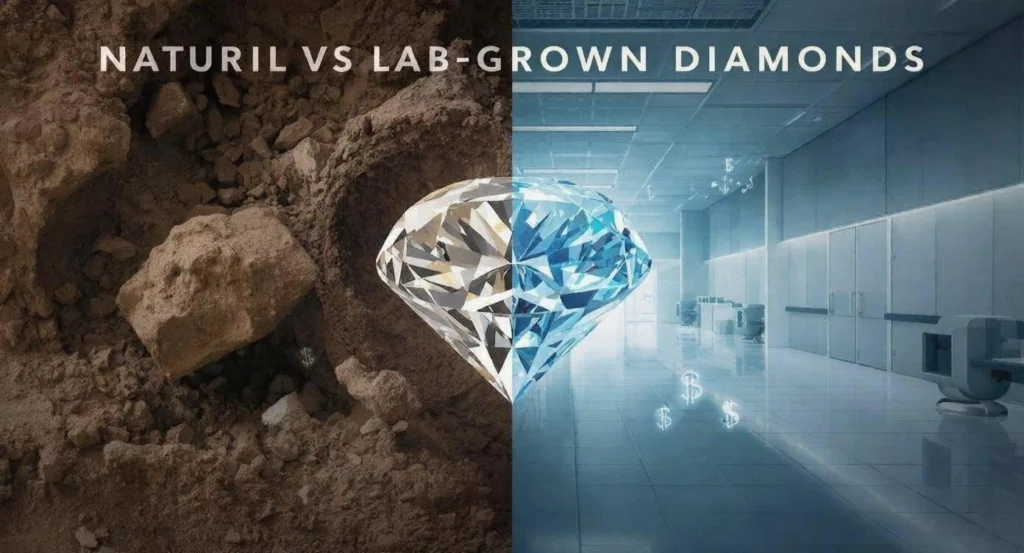
How does lab grown value compare to natural diamonds?
The difference between lab grown value and natural diamond value becomes most apparent at resale.
Natural diamonds benefit from controlled supply, historical demand, and established resale markets. Lab-grown diamonds, on the other hand, face continuous production increases—driving prices downward.
Key differences
Feature | Lab-Grown Diamonds | Natural Diamonds
Supply | Increasing rapidly | Limited
Price trend | Declining | Stable or slightly increasing
Resale demand | Lower | Higher
Market behavior
Natural diamonds often retain 50–70% of their retail value, depending on quality and brand. Lab-grown diamonds typically retain 20–40%, though this can vary.
Case study
A Las Vegas investor purchased two rings—one natural and one lab-grown—each valued at $10,000. After two years, the natural diamond sold for $6,500, while the lab-grown piece sold for $3,000.
Expert Insight
Industry analysts emphasize that lab-grown diamonds are best viewed as consumer goods, not investment assets.
Actionable takeaway
If resale value is a priority, natural diamonds still outperform. If upfront cost matters more, lab-grown diamonds offer strong value.
Why do lab diamonds lose value faster?
Understanding why lab diamond resale value declines helps you make informed decisions.
Core reason: supply scalability
Lab-grown diamonds can be produced in controlled environments. As technology improves, production costs decrease—leading to lower market prices.
H3: Technology impact
Advanced manufacturing techniques have reduced production time significantly. What once took weeks can now be done in days, increasing supply dramatically.
Market perception
Consumers often perceive lab diamonds as less rare, even though they are visually identical to natural diamonds. This perception impacts demand—and ultimately resale value.
Statistic
Morgan Stanley reported in 2024 that wholesale prices for lab-grown diamonds dropped nearly 20% year-over-year due to oversupply.
Real-world example
A Las Vegas jewelry reseller noted that lab diamonds purchased in 2022 are now worth 30–50% less in resale markets due to price drops.
Actionable takeaway
Expect depreciation. If you buy lab-grown, do it for enjoyment—not resale profit.
Can you resell lab diamonds easily in Las Vegas?
Reselling lab diamonds is possible—but not always easy, especially in a competitive market like Las Vegas.
Where you can sell
- Local jewelers
- Pawn shops
- Online marketplaces
- Auction platforms
Challenges you may face
- Lower demand compared to natural diamonds
- Price negotiations heavily favor buyers
- Limited resale channels specializing in lab-grown stones
Case study
A Las Vegas startup founder attempted to sell a lab-grown engagement ring through three channels. Online marketplaces offered better visibility, but local jewelers provided faster transactions—at lower prices.
Nevada-specific considerations
- Jewelers must comply with disclosure laws distinguishing lab-grown from natural diamonds
- Proper certification (such as IGI grading) increases resale credibility
Pro Tip
Always keep certification documents. Without them, resale value can drop significantly.
Actionable takeaway
Choose your selling channel based on priority: speed vs price.
What factors influence lab diamond resale value?
Several variables determine how much you can recover when reselling.
Key factors
Carat size
Cut quality
Color and clarity
Certification (IGI, GIA)
Market timing
H3: Certification matters more than you think
Certified diamonds command higher resale prices because buyers trust verified quality.
Real-world example
Two identical lab diamonds were listed for resale in Las Vegas. The certified one sold for 25% more than the uncertified piece.
Market timing
Selling during peak demand periods—like engagement season or Valentine’s Day—can improve offers slightly.
Expert Insight
Jewelry professionals recommend holding onto original packaging and receipts to boost buyer confidence.
Actionable checklist
- Maintain certification documents
- Choose high-quality cuts
- Time your sale strategically
- Keep jewelry in excellent condition
How can you maximize your resale value?
While you can’t eliminate depreciation, you can minimize losses.
Smart buying strategies
Choose classic designs
Avoid overly trendy styles
Invest in higher-quality stones
H3: Sell smarter, not faster
Rushed sales often lead to lower offers. Take time to compare multiple buyers.
Case study
A Las Vegas marketing manager waited three months before selling her lab diamond earrings. By comparing offers, she increased her final sale price by 18%.
Pro Tip
Consider resetting the diamond into a new piece instead of selling—it can preserve value in a different way.
Alternative approach
Some buyers choose to keep lab diamonds as long-term personal assets rather than reselling at a loss.
Actionable takeaway
Your exit strategy starts at purchase. Buy with resale in mind—even if you don’t plan to sell immediately.
Is buying lab diamonds still a smart decision?
Despite lower lab diamond resale value, these diamonds offer compelling advantages.
Benefits
Lower upfront cost
Ethical sourcing
Larger size for the same budget
Trade-off
You sacrifice long-term resale value for immediate affordability and aesthetics.
Real-world example
A Las Vegas entrepreneur chose a 2.5-carat lab diamond instead of a 1.5-carat natural diamond for the same price—maximizing visual impact.
Expert Insight
Financial advisors often recommend lab diamonds for consumers prioritizing lifestyle over investment returns.
Actionable takeaway
Define your goal before buying. If it’s emotional satisfaction, lab diamonds deliver. If it’s investment, look elsewhere.
Call to Action:
Are you ready to find the perfect engagement ring that fits your unique style? Explore our collection of oval and emerald-cut diamonds to discover the one that best suits you.
What Our Clients Are Saying
At DiamondNColors, we take pride in delivering exceptional service and exquisite jewelry. From diamond rings, engagement rings, and bracelets to gemstone pieces and more, our clients’ experiences speak for themselves. Explore our genuine testimonials to see how we bring elegance and quality to every piece, and share your own feedback here.
Conclusion
Lab diamond resale value is one of the most misunderstood aspects of modern jewelry buying.
While lab-grown diamonds offer exceptional beauty and affordability, they don’t hold value like natural diamonds. Understanding this upfront allows you to make confident, strategic decisions—whether you’re buying for love, lifestyle, or long-term planning.
Use this diamond resale guide as your framework. Focus on quality, documentation, and timing. And most importantly, align your purchase with your priorities.
If you’re ready to move forward, start by comparing options, verifying certifications, and choosing a diamond that fits your goals—not just your budget.
FAQs
1. What is the typical lab diamond resale value?
Lab diamond resale value usually ranges between 20% and 40% of the original purchase price, depending on quality, certification, and market conditions.
2. Do lab grown value trends change over time?
Yes. Lab grown value has declined in recent years due to increased supply and improved production technology, making diamonds more affordable but reducing resale potential.
3. Can I sell a lab diamond easily?
You can sell lab diamonds through jewelers, pawn shops, or online platforms. However, demand is lower than for natural diamonds, which may affect pricing.
4. Are lab diamonds a good investment?
No. Lab diamonds are better considered consumer purchases rather than investment assets due to their declining resale value.
5. Does certification affect resale price?
Yes. Certified lab diamonds typically sell for higher prices because buyers trust verified quality and specifications.
6. Is it better to keep or sell a lab diamond?
If resale offers are low, keeping the diamond or repurposing it into new jewelry may provide better long-term value.
7. How can I improve my resale outcome?
Maintain documentation, sell during high-demand periods, and compare multiple buyers to secure the best price.