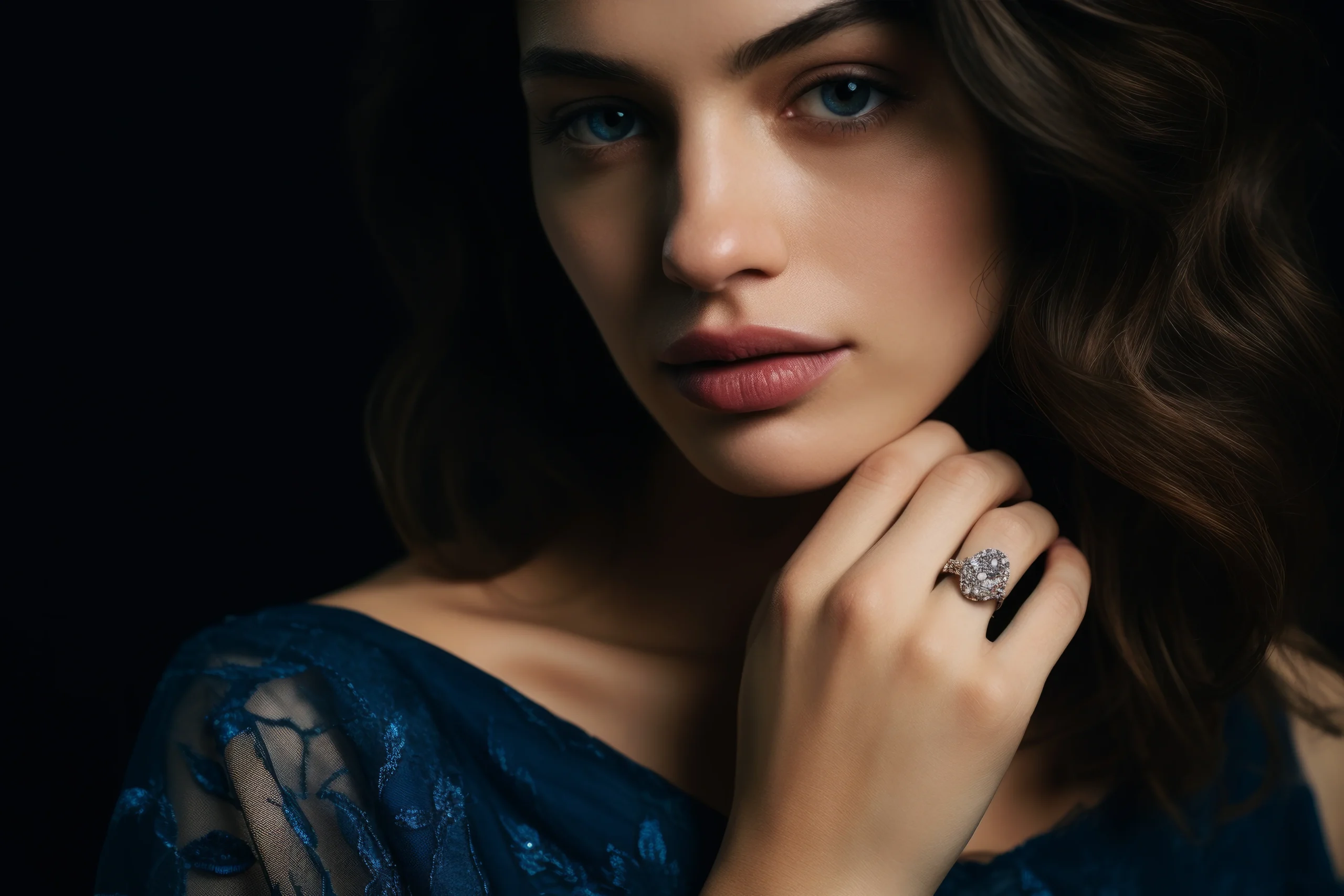
Oval diamonds now outsell princess cuts in the USA for the third consecutive year — a shift that would have seemed improbable a decade ago, when the square silhouette dominated bridal counters from Las Vegas to New York. According to The Knot’s 2025 Jewelry & Engagement Report, fancy-shaped diamonds (every shape other than round) now account for 52% of all engagement ring center stones purchased in the United States, a quiet revolution driven by buyers who want something that feels personal, not prescribed.
If you’re choosing a center stone and the shape decision is keeping you up at night, this diamond shapes guide is written for exactly that moment. You’ll learn how each major cut performs on brilliance, visual size, finger flattery, and price-per-carat — and you’ll leave with a clear sense of which shape suits your hand, your setting, and your story.
The answer is rarely obvious from a photo. But the right framework makes it clear.
The round brilliant cut, with its 57 or 58 precisely calculated facets, produces more light return than any other diamond shape. Developed through decades of optical research and formalized in GIA grading standards, it remains the most purchased diamond shape in the world — and the benchmark against which every other cut’s brilliance is measured.
The round brilliant isn’t popular because it’s traditional. It’s popular because it works. The mathematics behind its proportions — specifically the relationship between table percentage, depth percentage, and crown angle — were refined over the 20th century to maximize what gemologists call “total light return”: the combination of brilliance (white light), fire (spectral color flashes), and scintillation (the sparkle pattern as the stone moves).
GIA grades round brilliants on cut quality, a grade that encompasses all three optical performance dimensions. No other shape receives an official GIA cut grade, which is one reason round brilliants carry a pricing premium: the grading is more transparent, the performance more predictable, and the resale market deeper.
That premium is real and consistent. According to the Rapaport Diamond Report, a well-cut round brilliant typically commands 15–25% more per carat than a comparable fancy shape of the same color and clarity. For buyers focused purely on resale liquidity, this matters. For buyers focused on the experience of wearing a stone that throws light across a room, it also matters — just differently.
Elongated diamond cuts — oval, marquise, and pear — are among the strongest trending shapes in 2026, valued for their ability to create the visual illusion of a larger stone and flatter the finger with a lengthening effect. All three belong to the “brilliant” family of cuts and deliver fire and scintillation close to round brilliants, often at 20–30% lower cost per carat.
The surge in elongated diamond cuts trending across USA bridal markets isn’t arbitrary. Three forces are converging: buyers want maximum visual size for their budget, social media has normalized non-traditional silhouettes, and the fashion-forward aesthetic of elongated shapes pairs exceptionally well with the minimalist solitaire and sleek pavé settings dominating 2025–2026 design.
Oval: The most balanced of the three elongated shapes — symmetrical, finger-flattering, and brilliant without the pointed vulnerability of the other two. Length-to-width ratios between 1.35 and 1.50 are widely considered the most elegant. Below 1.30 and the oval reads almost round; above 1.55 and it can appear narrow in a setting. One caveat: ovals frequently exhibit a “bowtie effect” — a dark shadow across the middle of the stone caused by light escaping through the pavilion facets. Inspect any oval in person or via high-quality video before purchasing.
Marquise: The most dramatic elongated option, with pointed ends that extend the apparent length of the finger more than any other shape. Historically associated with the 1980s and early 2000s, the marquise has returned — reimagined in east-west settings and bezel mounts that give it a contemporary, architectural presence. Protect the points: they’re vulnerable to chipping without a prong or bezel covering each tip.
Pear: The pear — or teardrop — combines the oval’s soft curve with the marquise’s pointed tip, offering the most versatile orientation. Worn point-up toward the fingernail, it lengthens the finger. Worn point-down as a pendant, it draws the eye beautifully. Look for a pear with a well-defined rounded shoulder and a sharp, centered point for optimal symmetry.
In a cushion vs oval vs emerald cut comparison, each shape offers a fundamentally different visual character: the cushion delivers a soft, romantic brilliance with a vintage feel; the oval offers elongated, finger-flattering modern sparkle; and the emerald cut trades fire for a dramatic “hall of mirrors” effect that emphasizes clarity and color above all else. Your choice depends on the aesthetic you want and the quality trade-offs you’re willing to make.
This is the comparison that generates more DiamondsNColors consultation conversations than almost any other topic — and for good reason. These three shapes represent three distinct philosophies of diamond beauty.
| Attribute | Cushion Cut | Oval Cut | Emerald Cut |
|---|---|---|---|
| Facet style | Brilliant | Brilliant | Step-cut |
| Brilliance level | High | High | Lower — “mirror” effect |
| Fire & scintillation | Chunky, warm sparkle | Clean, bright sparkle | Minimal — elegant flash |
| Finger flattery | Moderate | High | Moderate–high (lengthening) |
| Visual size vs carat | Average | Above average | Above average (table size) |
| Clarity sensitivity | Moderate | Moderate | High — inclusions visible |
| Color sensitivity | Moderate | Moderate | High — color shows readily |
| Trending in 2026 | Yes (soft vintage revival) | Yes (dominant) | Yes (luxury minimal) |
| Price vs round | 15–25% less | 20–30% less | 20–35% less |
| Best setting styles | Halo, pavé, vintage | Solitaire, thin pavé | East-west, bezel, art deco |
The cushion suits buyers who want warmth and romance — a stone that glows rather than flashes. Modified cushion cuts (with an additional row of facets) produce more brilliance than classic cushions; ask your jeweler which style you’re considering.
The oval suits buyers who want brilliance with a contemporary silhouette. It photographs beautifully, wears comfortably, and occupies more surface area per carat than a round brilliant — a real advantage at the 1.0–1.5 carat range.
The emerald cut suits buyers who want architectural drama and don’t mind — or actively prefer — a stone that whispers instead of shouts. Its large, flat table surface means every inclusion and every tinge of color is visible, so emerald cuts reward investment in VS2 or better clarity and G color or higher.
Explore DiamondsNColors’ diamond grading guide (link: /diamond-grading-guide/) for a deeper explanation of how color and clarity grades interact with cut shape.
Princess and radiant cuts are square or rectangular brilliant-style diamonds that offer high brilliance in a geometric silhouette. While both have experienced declining market share relative to oval and cushion shapes, they remain strong choices for buyers who prefer angular, modern lines — and both offer meaningful cost advantages over round brilliants of the same carat weight.
The princess cut reached peak popularity in the early 2000s and has since ceded ground to softer shapes. But writing it off would be premature. The princess cut’s pointed corners give it a sharp, contemporary presence that suits certain personalities and architectural settings precisely — and it’s still one of the most efficient shapes for retaining rough diamond weight during cutting, which partially explains its competitive per-carat pricing.
Its vulnerability is also its defining feature: those four corners chip if exposed without prong protection. V-prong settings that cover each corner are the recommended configuration for any princess cut worn daily.
The radiant cut is the princess cut’s more forgiving cousin — cropped corners eliminate the chipping risk, and its faceting pattern (a hybrid of brilliant and step-cut elements) produces exceptional sparkle that’s warm and lively without the classical geometry of an oval or cushion. For buyers who want a square stone with more life than an emerald cut and more edge than a cushion, the radiant is an underappreciated option in 2026.
Both shapes are available for custom commission at DiamondsNColors (link: /custom-order/), where our design team can help you choose a setting that plays to each shape’s geometric strengths.
Diamond shape significantly affects price per carat, with round brilliants commanding the highest premiums and fancy shapes offering 15–35% savings at equivalent quality grades. In the USA market, oval and cushion cuts currently offer the best combination of visual impact and value, while emerald and marquise cuts can deliver exceptional perceived size at meaningfully lower cost — making shape one of the most powerful budget levers available to diamond buyers.
This is the part of the diamond shapes guide 2026 that can change your budget math entirely. Shape is one of the few diamond variables where a different choice — not a quality compromise — yields significant savings.
According to Rapaport Diamond Report pricing data, at a 1.50-carat equivalent in G color, VS1 clarity:
A round brilliant: highest market price baseline An oval or cushion: approximately 20–30% below round An emerald or marquise: approximately 25–35% below round A princess or radiant: approximately 20–28% below round
That gap represents thousands of dollars at higher carat weights — dollars that can fund a finer metal, more meaningful setting detail, or simply remain in your pocket. The oval at 1.5 carats will often appear larger than the round at 1.5 carats due to its elongated footprint, compounding the value advantage.
For Las Vegas buyers considering a larger center stone for a Strip proposal or destination wedding piece, this math is especially relevant. DiamondsNColors works with clients across Nevada and nationally (via diamondsncolors.com) to model out these comparisons before any purchase decision is made — because we believe an informed buyer makes a more satisfied client, always.
Diamond shape interacts meaningfully with finger length, width, and knuckle size. Elongated shapes like oval, marquise, and pear visually lengthen shorter or wider fingers. Round and cushion cuts suit most hand types and wear balanced on any finger width. Emerald and radiant cuts favor longer fingers where their rectangular proportions read as elegant rather than wide. No shape is universally unflattering — but proportion matching matters.
This question comes up in nearly every consultation at our Las Vegas showroom, and the honest answer is more nuanced than the ring-sizing guides suggest.
Short or wider fingers benefit most from elongated shapes — oval, pear, and marquise — which draw the eye along the length of the finger rather than across it. A length-to-width ratio of 1.40–1.60 in an oval provides the most pronounced lengthening effect without appearing too narrow in a ring setting.
Long, slender fingers can carry any shape beautifully, but particularly suit the bold geometry of an emerald cut or the lush presence of a large cushion. These fingers can also handle wider band settings without the ring overwhelming the hand.
Wide knuckles are best complemented by shapes with a wider footprint — cushion, oval, or round — rather than the pointed ends of marquise and pear, which can feel visually imbalanced against a broader knuckle.
The most reliable test remains trying the shape on your actual hand — in person where possible, or via a try-at-home service with representative stones. DiamondsNColors offers in-person consultations at our Las Vegas showroom (8965 S. Eastern Ave., Suite 160) and virtual consultations for buyers shopping nationally via diamondsncolors.com (link: /contact-us/).
For round brilliant diamonds, GIA issues a cut grade (Excellent, Very Good, Good, Fair, Poor) that objectively evaluates light performance, symmetry, and polish. For fancy shapes — oval, cushion, emerald, marquise, pear, princess, and radiant — GIA does not issue an official cut grade, making independent evaluation of proportions and light performance essential before purchase. Always request a GIA grading report and review symmetry and polish grades for any fancy shape.
The absence of a cut grade for fancy shapes is one of the most important — and least discussed — facts in diamond buying. It means that two oval diamonds with identical GIA color and clarity grades can perform completely differently in terms of brilliance, because one may have proportions that leak light and one may have proportions that return it beautifully. The certificate alone won’t tell you which is which.
For fancy shapes, experienced buyers and designers evaluate:
Length-to-width ratio: Determines the shape’s visual silhouette. Ranges vary by shape — consult a reputable grading guide for each.
Depth percentage: Affects light return. Too shallow or too deep, and brilliance suffers regardless of other factors.
Table percentage: The size of the top facet relative to the stone’s diameter, which affects how the stone’s brilliance appears face-up.
Symmetry grade: A GIA symmetry grade of Excellent or Very Good is advisable for any fancy shape, as asymmetry is immediately visible in elongated stones.
Bowtie or extinction: Inspect ovals, marquises, and pears for dark shadow patterns that diminish the stone’s face-up appearance.
DiamondsNColors’ diamond grading guide (link: /diamond-grading-guide/) walks through how to read GIA reports for both round and fancy shape diamonds. Our team reviews these details for every stone we source — because the certificate is the start of the evaluation, not the end of it.
Your diamond shape is the first thing people notice and the last thing you’ll want to reconsider. So make the decision from a position of knowledge, not anxiety.
From this diamond shapes guide 2026, carry these four things forward: the round brilliant maximizes brilliance and resale liquidity, but fancy shapes offer meaningful savings and often more visual size for the same budget. Elongated cuts — oval, marquise, pear — are the defining trend of 2026 and flatter a wide range of hand types. Emerald cuts reward investment in higher clarity and color grades. And for any fancy shape, proportion and symmetry matter as much as the GIA color and clarity grades on the certificate.
What is the most brilliant diamond shape in 2026?
The round brilliant cut produces the most brilliance of any diamond shape, thanks to its 57–58 precisely calculated facets optimized for maximum light return. GIA grades round brilliants on cut quality — a transparency advantage no fancy shape currently receives. For buyers prioritizing fire and scintillation above all else, the round brilliant remains the benchmark in 2026 and beyond.
Which diamond shape looks the biggest for the money?
Oval, marquise, and emerald cuts typically appear larger per carat than round brilliants because their elongated or wide table footprints cover more finger surface. An oval diamond can appear 10–15% larger than a round of the same carat weight. Fancy shapes also cost 20–35% less per carat than round brilliants, compounding the value advantage for budget-conscious buyers.
Is an oval or cushion cut better for an engagement ring?
Oval cuts offer a more elongated, finger-flattering silhouette and slightly more visual size per carat, while cushion cuts deliver a softer, more romantic warmth with a vintage-influenced sparkle. Ovals are currently more dominant in 2026 bridal trends per The Knot’s annual report, but cushions remain a strong choice for buyers who prefer a square or rounded-square shape with high brilliance.
What diamond shape is best for short fingers?
Elongated diamond shapes — oval, pear, and marquise — visually lengthen shorter fingers by drawing the eye along the finger’s length rather than across it. An oval with a length-to-width ratio of 1.40–1.55 provides the most flattering effect for shorter or wider fingers. Round and cushion cuts are also flattering but don’t provide the same lengthening illusion.
Does GIA grade fancy shape diamond cuts?
GIA does not issue an official cut grade for fancy shape diamonds — including oval, cushion, emerald, marquise, pear, princess, and radiant cuts. For fancy shapes, buyers should evaluate symmetry and polish grades on the GIA report and independently assess proportion ratios, depth percentage, and table percentage. Consulting a knowledgeable jeweler to review these factors before purchase is strongly advisable.
Which diamond shape holds its value best for resale in the USA?
Round brilliant diamonds historically hold the strongest resale value in the USA due to their universal demand, GIA cut grading transparency, and deep secondary market. Among fancy shapes, oval and cushion cuts have demonstrated the strongest resale performance in recent years, driven by sustained consumer demand. Emerald and marquise cuts are more niche at resale but command premiums among collectors who seek them specifically.