If you’ve been drawn to the rich, grounding warmth of brown and champagne gems — or you’re simply curious whether a coffee diamond belongs in your collection or on your finger — this guide gives you everything you need. You’ll learn what coffee and champagne diamonds actually are, how they’re graded and priced, which companion gemstones complete the Mocha Mousse palette, and how to build a look that feels both genuinely current and enduringly beautiful. The story of these warm-toned stones is more surprising than any trend cycle.
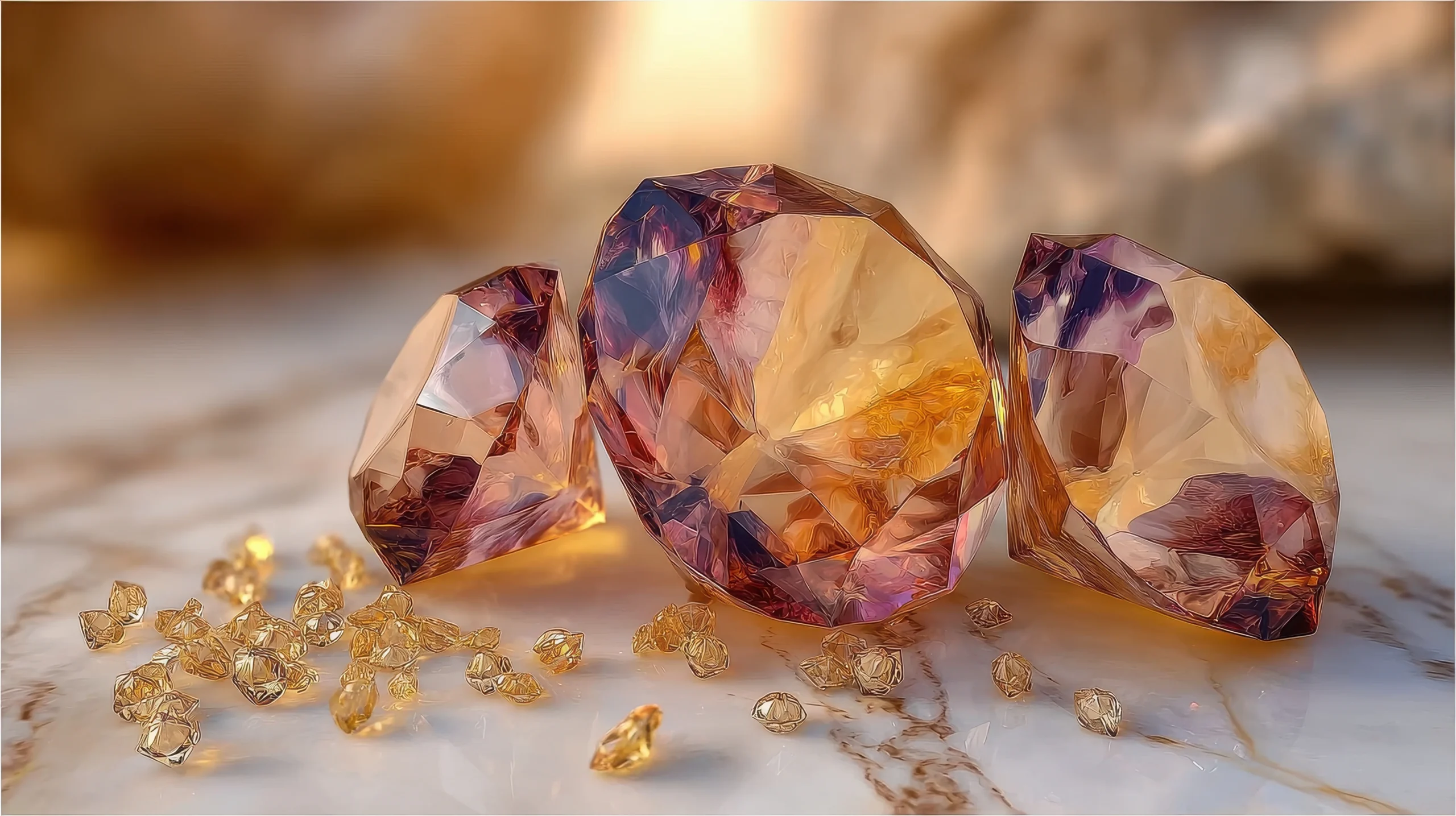
A coffee diamond is a naturally brown-colored diamond graded by the GIA either on the standard D-to-Z color scale (where brown appears from the K–Z range) or as a GIA Fancy Color diamond for deeply saturated stones. “Coffee,” “champagne,” and “cognac” are trade names — not GIA grades — describing a real spectrum from pale golden-tan to deep, dark brown.
The GIA never uses “coffee” or “champagne” on a grading report. These terms were developed and popularized by the Argyle Diamond Mine in Western Australia — responsible for approximately 80% of the world’s brown diamond supply before its closure in November 2020. Argyle created a classification system running from C1 (palest champagne) through C7 (deepest coffee-brown), giving the trade language that endures today.
The Brown Diamond Spectrum
- Champagne (C1–C3): Pale straw to warm honey. These stones seem to glow from within when set in yellow gold, the metal amplifying the gem’s warmth rather than competing with it.
- Cognac (C4–C5): Deep amber to rich whiskey. Rose gold is a natural partner here — its pink undertones play beautifully against the amber saturation.
- Coffee (C6–C7): The richest, darkest expression — a luxurious chocolatey brown that deepens under warm light. These are the rarest in the brown spectrum and command the strongest collector attention.
Brown diamonds owe their color to plastic deformation in the crystal lattice — a structural shift that occurs during formation deep in the earth, not a chemical impurity or treatment. This is entirely natural. A GIA Fancy Color Diamond Report will specify grades like “Fancy Brown” or “Fancy Dark Brown” with no stigma attached. The Rapaport Diamond Report has tracked steady appreciation in fine fancy brown diamonds since the Argyle closure reduced global supply, making well-graded coffee diamonds increasingly compelling as both jewelry and investment.
DiamondsNColors’ diamond grading guide (link: /diamond-grading-guide/) explains exactly how to read a GIA fancy color report — so you understand every detail before you fall in love with a stone.
Pantone’s Mocha Mousse (PANTONE 17-1230) — a rich, enveloping brown evoking warmth, comfort, and nature — has accelerated demand for coffee diamond jewelry and warm-toned gems across the USA fine jewelry market in 2026. Jewelers of America’s 2025 market update reported warm-toned and fancy color diamonds saw the strongest consumer interest growth of any diamond category, outpacing lab-grown colorless stones among Millennial engagement ring buyers.
The Pantone Color of the Year has a documented track record of reshaping fine jewelry purchasing behavior. Living Coral (2019) drove a measurable surge in morganite and padparadscha sapphire interest. Classic Blue (2020) correlated with increased aquamarine and blue sapphire searches on major retail platforms. The mechanism is intuitive: buyers who’ve already invested in Mocha Mousse-toned clothing, leather goods, or home furnishings instinctively seek jewelry that harmonizes with — rather than contrasts — the aesthetic they’ve already committed to.
For 2026, this creates a rare opportunity. Coffee and champagne diamonds remain significantly more accessible in price than equivalent colorless or fancy yellow diamonds. A 1-carat GIA-certified fancy brown diamond of excellent cut and strong saturation can be acquired for a fraction of the cost of a D-color, VS1 colorless diamond of the same weight — and in this moment, it carries the stronger cultural resonance. That combination of aesthetic relevance and price accessibility is unusual in fine jewelry, and it won’t last indefinitely. As Argyle-era inventory continues to thin, the finest fancy brown diamonds are already attracting collector-grade attention.
Explore DiamondsNColors’ new collections (link: /new-collections/) to see how we’re interpreting the Mocha Mousse palette in current bespoke and ready designs.
Beyond coffee diamonds, the Pantone Mocha Mousse palette unlocks a rich world of warm-toned gemstones for 2026: smoky quartz, imperial topaz, hessonite garnet, Mali garnet, cognac spinel, and brown sapphire all carry the earthy depth of this color story. Each brings its own character — and its own price point — to warm-toned gemstone jewelry in 2026.
Smoky Quartz: Often underestimated, a well-cut smoky quartz in a deep, clear brown is breathtaking in person. At Mohs 7, it’s durable enough for pendants, earrings, and occasional-wear rings. The price point is accessible, making it an ideal entry point into the warm-toned aesthetic, and the size possibilities — smoky quartz is readily available in 10+ carat stones — allow for genuinely dramatic designs.
Imperial Topaz: A deep orange-brown to golden-brown topaz, with the finest specimens coming from Ouro Preto, Brazil. Imperial topaz has a high refractive index (RI 1.609–1.643) that produces exceptional brilliance — it catches light with an almost adamantine quality that photographs cannot fully capture. Fine imperial topaz commands $1,000–$3,500 per carat and is increasingly sought by collectors.
Hessonite Garnet: The warmest member of the grossular garnet family, hessonite ranges from honey-orange to deep cinnamon-brown. Sri Lanka produces the finest specimens. It has a distinctive, slightly turbid internal quality that gem traders call “treacly” — a warmth that feels ancient and organic rather than flashy.
Cognac Spinel: Rare and largely unknown to mainstream buyers, brown-orange spinel from Tanzania and Myanmar offers Mohs 8 hardness, no treatments (spinel is almost never enhanced), and a brilliance that rivals ruby and sapphire. A cognac spinel of 2+ carats with strong color is a genuine find — and at current prices, an intelligent one.
💎 DiamondsNColors Designer’s Note Our design team has noticed something consistent when clients see cognac spinel or imperial topaz for the first time in our Las Vegas showroom: they’re surprised by the warmth these stones generate in person compared to photographs. Warm-toned gems respond to light in a way that reads as golden and alive — particularly under candlelight or the warm ambient lighting of an evening setting. If you’re building a look around Mocha Mousse, we’d encourage you to see these stones before deciding. The experience changes the decision.
Brown and champagne diamond rings pair most beautifully with yellow gold (18K or 22K) and rose gold, where the warm metal tones amplify the stone’s earthy richness rather than cooling it. White gold and platinum — which read as cool and neutral — can work for contrast-forward designs but generally diminish the cohesion of the warm-toned aesthetic that makes coffee diamond jewelry compelling.
Yellow Gold: The classic pairing. An 18K yellow gold solitaire with a deep cognac or coffee diamond creates a monochromatic warmth that feels both ancient and completely contemporary. For a Las Vegas proposal or a significant anniversary piece, this combination photographs magnificently and wears as a complete, considered design rather than a default choice.
Rose Gold: For champagne and lighter cognac tones, rose gold introduces a rosy, romantic quality that softens the stone’s earthiness into something more delicate. This pairing works especially well in pavé settings, where the rose gold micro-diamonds surrounding a champagne center stone create a seamless gradient of warm color.
Two-Tone Designs: For the buyer who wants complexity, a yellow gold bezel with a white gold shank offers the warmth of yellow where the stone sits, with a contemporary cool-toned band — a contrast that allows the coffee diamond to anchor the design visually.
Metal Purity: For any warm-toned design, DiamondsNColors recommends 18K over 14K for yellow gold — the higher gold content produces a richer, more saturated yellow that elevates the stone beside it. Our Know Your Gold guide (link: /know-your-gold/) explains the practical and aesthetic differences between gold purities in detail.
| Warm Gem | Best Metal | Best Setting Style | Price Range (per carat) |
|---|---|---|---|
| Coffee Diamond (C6–C7) | 18K Yellow Gold | Bezel, East-West Oval | $800–$4,000+ |
| Champagne Diamond (C1–C3) | Rose or Yellow Gold | Pavé Halo, Solitaire | $400–$2,500 |
| Imperial Topaz | 18K Yellow Gold | Bezel, Cushion Solitaire | $1,000–$3,500 |
| Hessonite Garnet | Yellow or Rose Gold | Antique Cushion | $80–$600 |
| Cognac Spinel | Yellow Gold | East-West Bezel | $300–$2,000+ |
| Smoky Quartz | Rose Gold | Statement Cocktail | $20–$150 |
Buying coffee diamond jewelry in Las Vegas gives you a genuine advantage: the ability to evaluate warm-toned stones under multiple light sources — natural, incandescent, and LED — which is essential for assessing how a brown or champagne diamond’s color performs across real-world conditions. The annual JCK Las Vegas jewelry trade show brings world-class fancy color diamond inventory to Southern Nevada each June, making the local market exceptionally well-supplied.
Before purchasing any coffee or champagne diamond above $3,000, ask these questions:
- Does this stone have a GIA Fancy Color Diamond grading report specifying its exact color grade?
- Is the color grade on the D-to-Z scale, or does the stone qualify as a GIA Fancy Color diamond?
- Has the color been enhanced through any treatment (HPHT processing can turn some brown diamonds colorless or yellow — you want to confirm the color is natural)?
- What is the cut quality, and how does it affect how the color distributes across the stone?
- How does the stone appear in natural daylight versus incandescent light?
The GIA’s Fancy Color Diamond grading reports are the gold standard for brown and champagne diamonds. An HPHT-treated diamond — one that has been subjected to high-pressure, high-temperature processing to alter its color — must be disclosed, and its value is significantly different from a naturally colored stone. Always confirm the report specifies “natural color” and check for any treatment disclosures.
Coffee diamond jewelry carries genuine investment potential in 2026, driven by two converging factors: the permanent closure of the Argyle Mine in 2020, which eliminated roughly 80% of global brown diamond supply, and the cultural momentum of the Pantone Mocha Mousse trend elevating collector and consumer demand simultaneously. Fine, GIA-certified fancy brown diamonds at 1 carat and above have appreciated steadily since 2020, per Rapaport market tracking.
Investment-grade fancy color diamonds — including browns — are evaluated on four factors beyond the standard 4Cs: color distribution (even vs. concentrated), fluorescence (can enhance some brown diamonds’ color under UV), origin documentation, and the specificity of GIA color grading. A stone graded “Fancy Intense Brown” with even color distribution and a GIA report is a meaningfully different asset from a K-color diamond described informally as “champagne” by a retailer without documentation.
The Argyle factor is real and measurable. Since November 2020, the pipeline of new Argyle-origin fancy colored diamonds entering the market has been zero. Argyle-certified brown diamonds — those accompanied by the mine’s distinctive pink certificate of authenticity — command a growing premium among collectors, particularly for stones in the C5–C7 range. The Natural Diamond Council has noted that Argyle-origin stones of all colors are increasingly sought at auction.
For buyers who want the Mocha Mousse aesthetic with long-term value considerations, the guidance is consistent: buy GIA-certified, buy natural color, buy the best cut you can afford, and prioritize color saturation over carat size. A vivid 0.8-carat fancy intense brown diamond will outperform a pale 1.5-carat “champagne” stone in every dimension — beauty, wearability, and retained value.
DiamondsNColors’ custom design studio (link: /custom-order/) can source GIA-certified fancy brown diamonds to your specifications and build a setting that honors both the stone and the moment it represents.
Styling warm-toned gemstone jewelry in 2026 means building around the Mocha Mousse palette intentionally — layering champagne diamonds with imperial topaz, cognac spinel with yellow gold stackers, or a coffee diamond solitaire with hessonite garnet drop earrings. The aesthetic rewards cohesion: warm stone, warm metal, warm skin tones amplified rather than competed with.
Stacking for the Mocha Mousse Look
Stackable rings are the most versatile entry point into warm-toned jewelry. A thin 18K yellow gold band with champagne diamond pavé, stacked beside a cognac sapphire bezel ring and a plain polished gold band, creates the layered warmth that defines the 2026 aesthetic without requiring a significant single investment.
DiamondsNColors’ stackable rings collection (link: /collections/) includes options in yellow and rose gold across multiple price points — designed specifically for mixing, matching, and building over time.
Statement Pieces
For a single statement piece, a coffee diamond oval or cushion in a yellow gold bezel setting is the 2026 equivalent of the classic diamond solitaire — immediately recognizable as intentional and sophisticated, yet entirely personal. Pair it with nothing at all, or with simple gold hoops, and let the stone do its work.
Skin Tone Considerations
Warm-toned gems are particularly flattering on medium-to-deep skin tones, where the contrast between the stone’s earthy warmth and skin creates a luminous interplay. On fair skin, champagne and lighter cognac tones read beautifully; deeper coffee browns can appear very dark without sufficient surrounding light or a high-polish gold setting to lift the stone.
The stones you wear are a record of who you were when you chose them — and choosing a coffee diamond or a warm-toned gem in 2026 says something specific: that you trust your own eye, that you value the particular over the generic, and that you understand beauty doesn’t require conformity. Here are four things to carry with you from this guide:
- Coffee, champagne, and cognac are a spectrum, not a single thing. Know where on the C1–C7 scale your stone falls — and ask for the GIA report that documents it.
- Yellow and rose gold are not optional. The metal matters as much as the stone for warm-toned designs.
- The Argyle closure is real. Fine natural fancy brown diamonds are becoming scarcer. Buying well now is buying ahead of the curve.
- Companion gems make the look. Imperial topaz, hessonite garnet, and cognac spinel are the supporting cast that elevates coffee diamond jewelry from a single statement to a full aesthetic.
Whether you’re drawn to coffee diamond jewelry for its cultural moment, its investment logic, or simply because it is the most beautiful thing you’ve ever seen on your finger — our team at DiamondsNColors in Las Vegas is here to guide you to exactly the right piece for your story. Explore our collections online or book a private consultation at our Las Vegas showroom. (link: /contact-us/)
You might also enjoy: Fancy Colored Diamonds: Blue, Green, and Red and Stackable Rings Trend 2026 — both available on the DiamondsNColors blog.
What is a coffee diamond, and is it a real diamond?
A coffee diamond is a completely real, natural diamond with a deep brown color graded by the GIA on its standard or Fancy Color grading scale. The term “coffee” is a trade name — not a GIA designation — describing the richest, darkest end of the brown diamond spectrum. Coffee diamonds are mined, not treated or manufactured, and carry full GIA certification like any other natural diamond.
Is coffee diamond jewelry a good investment in 2026?
Coffee diamond jewelry carries genuine investment potential in 2026, driven by the 2020 permanent closure of the Argyle Mine — which produced roughly 80% of the world’s brown diamonds — and rising demand from the Pantone Mocha Mousse trend. GIA-certified natural fancy brown diamonds at 1 carat and above have appreciated steadily since supply was curtailed. Prioritize GIA documentation, natural color confirmation, and strong saturation for the best long-term value.
What is the difference between a champagne diamond and a coffee diamond?
Champagne and coffee diamonds sit at opposite ends of the brown diamond spectrum. Champagne diamonds (Argyle grades C1–C3) range from pale straw to warm honey — lighter, more golden in tone. Coffee diamonds (C6–C7) are the richest, darkest expression — a deep, chocolatey brown. Cognac diamonds (C4–C5) fall between the two. All are natural diamonds graded by the GIA with no negative implication attached to their color.
How much does a coffee or champagne diamond ring cost in the USA?
In the USA in 2026, champagne diamonds (lighter tones) range from approximately $400–$2,500 per carat, depending on cut quality and saturation. Coffee diamonds at the darker C6–C7 range command $800–$4,000+ per carat for GIA-certified stones with strong color. The complete ring price depends on setting, metal, and total carat weight — custom designs at fine studios typically start around $3,000–$5,000 for a meaningful center stone.
What gemstones go well with the Pantone 2026 Mocha Mousse color in jewelry?
The warmest companion stones for the Pantone Mocha Mousse palette include imperial topaz (deep orange-brown, extraordinary brilliance), hessonite garnet (honey to cinnamon, from Sri Lanka), cognac spinel (amber-orange, Mohs 8, almost never treated), and smoky quartz (accessible, available in dramatic sizes). All pair beautifully with 18K yellow or rose gold settings to create a cohesive, earthy warmth that defines the 2026 fine jewelry aesthetic.
How do I care for a coffee diamond or warm-toned gemstone ring?
Coffee and champagne diamonds are as durable as any natural diamond — Mohs 10 — and require standard diamond care: gentle cleaning with warm water, mild dish soap, and a soft brush; periodic professional cleaning; and secure prong inspection every 12–18 months. Companion warm-toned stones like smoky quartz (Mohs 7) and hessonite garnet (Mohs 6.5–7.5) require more care — avoid ultrasonic cleaners and protect from hard impact in daily wear.